Why Startups Are Replacing In-House Design Teams with Outsourced Web Design Services
Founders are decisive people by nature. They make calls on product, pricing and positioning without blinking. They will debate a hiring decision for a week and then move on to it in a day. They can hold ten things in their head simultaneously and still show up sharp to a 7 AM investor call.
But ask them about their website and something changes. Suddenly, there are competing opinions, half-finished briefs and a to-do item that has been sitting on the list since quarter one. The designer who was supposed to handle it is stretched across three other projects. The developer who touched it last has since moved on. And the version that is live right now? It was good enough at the time.
The website is never urgent until the moment it becomes the reason a deal did not close or a candidate chose a competitor or the reason a warm lead went quiet after doing their research. This is the gap that outsourced web design services were built for. Not as a last resort and not as a budget workaround, but as a deliberate, structured solution for companies that need a professional web presence without the overhead of building a permanent team to maintain one.
The Real Cost Is Not the Invoice – It Is the Time
When founders talk about why they did not build an in-house design team earlier, the answer is rarely money alone. It is time. Recruiting, onboarding, managing and retaining a skilled web design team inside an early-stage startup is a full-time undertaking. And in the first two years, that time is simply not available.
Startups operate on compressed timelines. A product launch cannot wait four months for a hiring cycle to complete. A redesign cannot stall because the one designer on staff is already allocated elsewhere. Executable speed requires access to people who are ready to work now.
This is why the conversation around outsourcing has shifted. It is no longer about cutting corners. It is about removing the structural bottlenecks that slow early-stage companies down at exactly the wrong moment.
How Outsourced Teams Actually Work for Startups
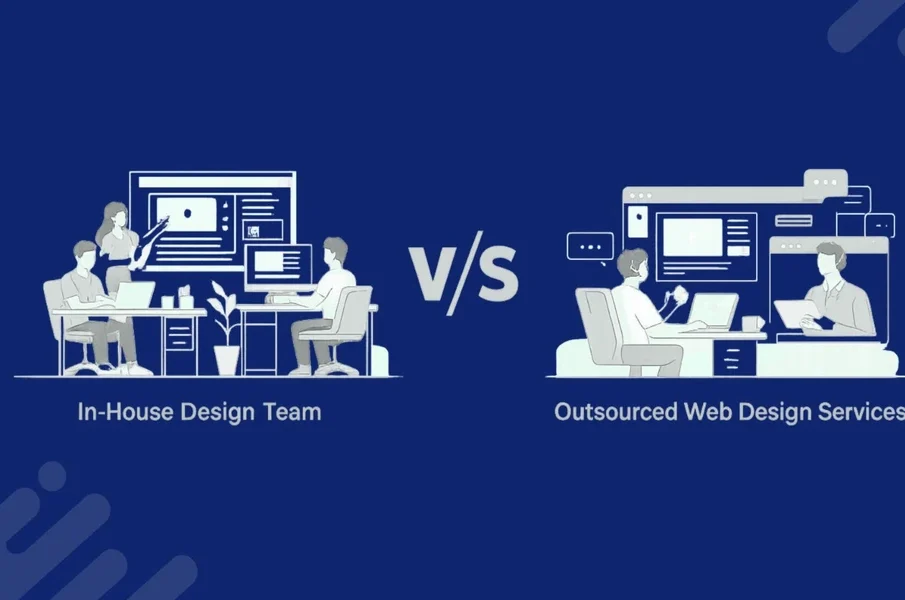
The mechanics of outsourcing have matured considerably. What was once a transactional arrangement, hand over a brief, receive a deliverable, repeat has evolved into something far more collaborative. Modern outsourced web design engagements work closest to an extension of your internal team: same communication tools, shared project boards, regular video check-ins and genuine accountability.
What makes this model particularly well-suited to startups is the flexibility it provides across three specific dimensions:
- Skill coverage without full-time overhead: A single outsourced team can include a UX designer, a front-end developer and a visual designer roles that would represent three separate hires internally.
- Scale on demand: Startup workloads are not linear. Outsourced teams can be scaled up for a major launch and reduced between projects, without the friction of redundancy conversations.
- Access to proven processes: Established outsourced teams bring workflow discipline design systems, version control, review cycles that early-stage startups rarely have time to build themselves.
If you are at the stage where your web presence is holding back your growth and many startups reach this point sooner than they expect, it may be worth exploring what a structured outsourcing partnership looks like for your specific brief.
Why India Has Become the Default Answer for Offshore Web Talent
The decision to work with offshore web designers in India is not simply about cost, even though the cost advantage is real and material. It is about talent density. India has one of the largest concentrations of English-proficient, internationally experienced web professionals in the world across disciplines ranging from UI/UX design to full-stack development to product strategy.
Startups that choose to hire remote web designers in India are accessing a talent pool that has been shaped by years of working with European and North American product companies. The communication norms, project management expectations and delivery standards are broadly aligned. The time zone overlap, particularly for European companies, is workable. And the quality of output, when the right partner is selected, is demonstrably high.
What this means in practice is that a startup can have a fully functioning, professionally designed website in a fraction of the time and cost it would take to recruit and onboard a comparable team locally.
What Exactly Are Outsourced Web Design Services?
Outsourced web design services refer to the practice of engaging an external team or agency typically located in a different country, to handle the design, development and maintenance of a company’s website or digital product. Unlike freelance arrangements, these engagements usually involve a dedicated team that works exclusively on your project for a defined period, following structured processes and reporting directly to your internal stakeholders.
For startups specifically, this model offers the ability to launch or overhaul a web presence without committing to permanent headcount, making it one of the most capital-efficient approaches available at the early stage.
AI Can Generate a Layout, But It Cannot Build a Brand.
There is a version of this conversation that skips outsourcing entirely and goes straight to AI-generated design. Tools that produce wireframes, suggest colour palettes and auto-generate copy from a brief are genuinely useful. They have accelerated certain parts of the design process in ways that would have seemed implausible five years ago.
But there is a meaningful distinction between generating design assets and making design decisions. The latter requires an understanding of your market positioning, your audience’s psychology, your competitive context and the specific story your brand needs to tell at this stage of its growth. No AI tool currently on the market can gather that understanding and apply it with the judgment of an experienced human designer working inside your brief.
The smarter approach and the one that leading startups are increasingly taking is to combine the efficiency of AI-assisted tools with the strategic and creative judgment of a dedicated web design team in India. Automation handles the repetitive. Human expertise handles the consequential.
Where Structure Meets Execution: How Citadel Coworkers Supports Startup Web Teams
Most outsourcing conversations focus on the talent side. Citadel Coworkers operates one layer deeper than that, addressing the infrastructure and environment in which that talent works.
For startups working with remote or hybrid web design teams, the quality of the working environment directly affects output. Collaboration suffers in poor connectivity. Creativity stalls in poorly designed spaces. Coordination breaks down without the right physical and digital infrastructure in place.
Citadel Coworkers provides managed coworking and distributed team infrastructure that is purpose-built for exactly this kind of arrangement. They can operate from a professional environment with enterprise-grade connectivity, private meeting rooms and a setup that reflects the standards of your brand rather than a home office corner.
This matters because clients notice. A team presenting over a choppy connection from a cluttered background is not the same experience as a team presenting from a structured, professional environment. The work may be identical. The confidence it inspires is not.
Making the Outsourcing Decision: What Startups Actually Need to Know
The decision to outsource web design is straightforward in principle. The execution is where most startups either get it right or lose time they cannot recover. A few considerations that tend to separate successful engagements from frustrating ones:
- Brief quality matters more than budget: A vague brief produces vague output regardless of how talented the team is. Invest time upfront in documenting your goals, audiences, competitors and design preferences.
- Prioritise communication infrastructure: The biggest predictor of outsourcing success is not location or time zone, it is the quality of daily communication. Agree on tools, rhythms and escalation paths before work begins.
- Treat the team as internal: Startups that achieve the best outcomes from outsourcing are those that include the external team in product conversations, not just execution tasks. Context produces better design.
The Startups That Move Fastest Are Not Building Everything Themselves
There is a quiet confidence in the founders who have figured this out. They are not scrambling to hire designers they cannot afford or making do with a web presence that does not reflect their actual ambition. They have found capable partners, structured the relationship well and redirected their own energy toward the things only they can do.
Outsourcing web design is not a shortcut. It is a deliberate allocation of resources one that acknowledges where your competitive advantage actually lies and removes the barriers between your vision and its execution. The startups that understand this early do not just launch faster. They build better because they are not stretched across functions they were never meant to own.
Your product is the priority. Your web presence should reflect that and it does not need to come at the cost of your team’s time, your runway or your sanity.


